Last year, a founder proudly showed a dashboard with 1.2 million impressions. Revenue was flat. Pipeline was thin. Cash flow was tight. That dashboard represented applause, not income. For B2B founders, CEOs, and C-suite leaders, the uncomfortable truth is this: AI applied to vanity metrics accelerates distraction. AI aligned to Revenue Operations multiplies margin.
The Real Problem: AI Is Being Optimized for Attention, Not Income
Many AI tools promise faster content creation, automated engagement, and growth at scale. But growth without revenue integrity is fragile. Vanity metrics such as followers, impressions, views, and engagement rates may look impressive, but they do not guarantee qualified pipeline, conversion efficiency, margin expansion, or revenue predictability. Executives do not need more noise. They need predictable revenue systems.
What AI in Revenue Operations Should Actually Do
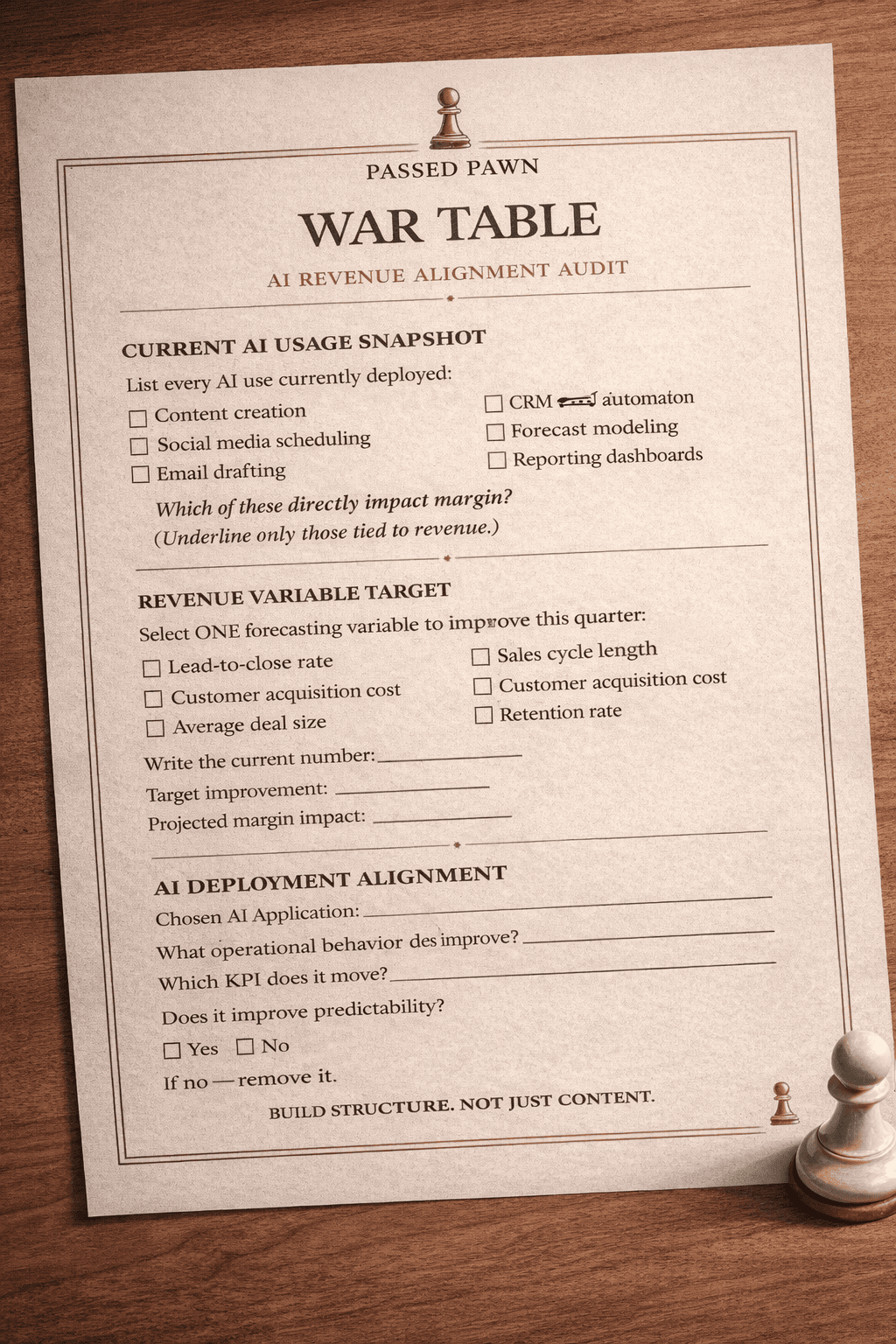
AI in Revenue Operations is not a marketing assistant. It is a margin optimizer. Properly aligned AI should directly impact at least one of these five revenue levers:
- Increase Conversion Rate through intent signal analysis and lead prioritization.
- Reduce Customer Acquisition Cost by identifying high-performing segments.
- Increase Average Deal Size through predictive cross-sell modeling.
- Improve Retention and Lifetime Value by detecting churn risk early.
- Accelerate Sales Velocity by reducing deal stall and pipeline drag.
The Margin Expansion Model: From Visibility to Profit
Revenue Operations aligns marketing, sales, finance, and data. AI becomes powerful when integrated into CRM systems, attribution tracking, pipeline health scoring, and forecasting dashboards. Without integration, AI is a content factory. With integration, AI becomes a revenue intelligence engine.
The Forecasting Advantage: From Guessing to Modeling
Most leadership teams forecast using optimism layered over historical averages. AI enables disciplined predictive modeling by analyzing conversion ratios, sales cycle duration, segment profitability, and seasonal trends. Forecasting becomes controllable when AI models revenue scenarios based on data, not assumptions.
The Risk of AI Misalignment
AI misalignment creates silent risk including inflated assumptions, budget misallocation, pipeline distortion, and data contamination. If AI feeds poor data into your systems, forecasts become unreliable. Unreliable forecasts lead to flawed capital allocation decisions. AI should reduce risk, not multiply it.
The AI Alignment Scorecard
- Is this tied to a measurable revenue KPI?
- Is it integrated with CRM and pipeline tracking?
- Does it reduce operational friction?
- Does it improve forecasting accuracy?
- Does it increase profit predictability?
From Vanity to Value: A Leadership Shift
AI does not replace leadership discipline. It magnifies it. Executives who win with AI start with financial outcomes, map initiatives to revenue levers, and continuously refine based on measurable contribution margin. They engineer predictability instead of chasing volume.
The Bottom Line
AI in Revenue Operations is not about doing more. It is about doing fewer things with higher financial impact. Vanity metrics inflate ego. Revenue metrics build enterprise value. If your AI strategy improves visibility more than EBITDA, it is misaligned. The future belongs to disciplined operators who treat AI as a profit instrument.