How to Scale Your Business With AI and Systems
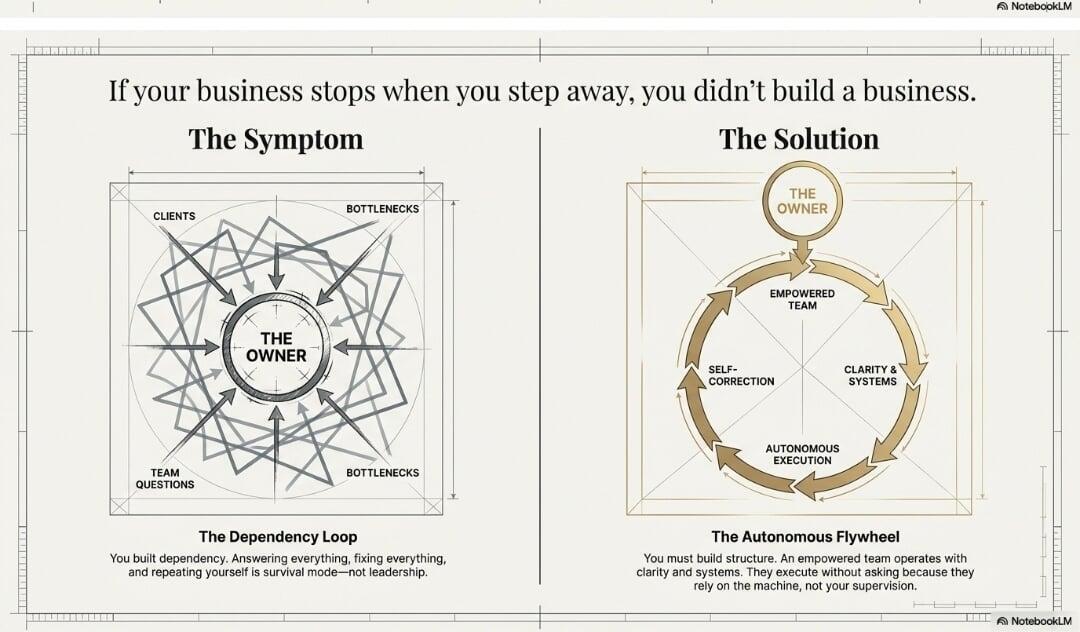
If your business slows down or stalls the moment you step away, let's not sugarcoat it: that’s not bad luck, it’s bad structure. Without realizing it, you didn't build a self-sustaining company; you built a system of dependency.
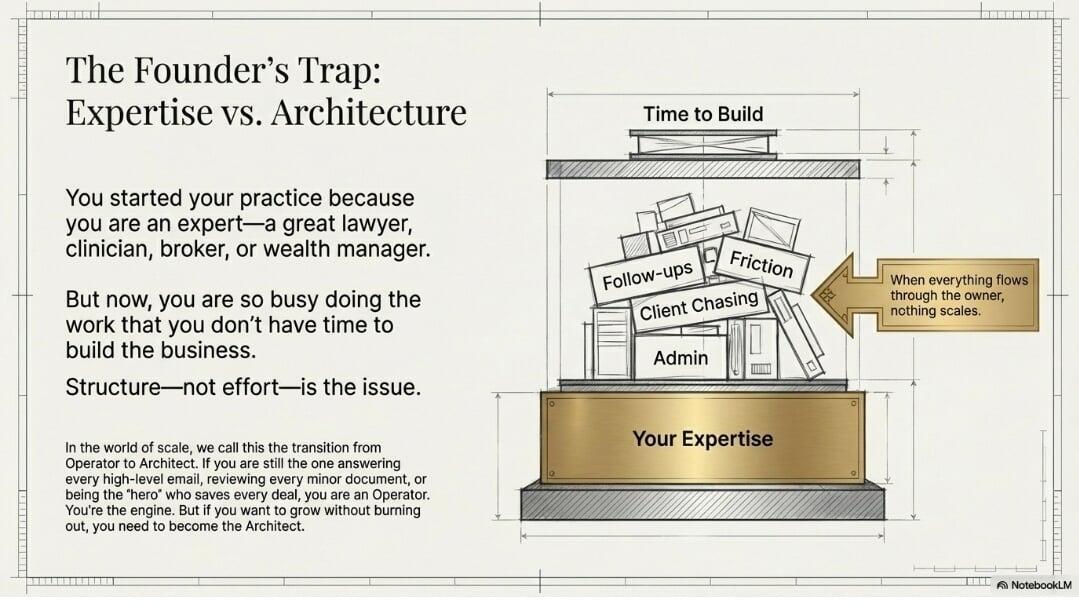
Many entrepreneurs fall into the classic Founder’s Trap. You likely started your firm or practice because you are a brilliant expert—a great lawyer, a skilled clinician, a savvy broker, or a talented wealth manager. But eventually, you become so busy executing the day-to-day work that you no longer have the time to actually build the business.
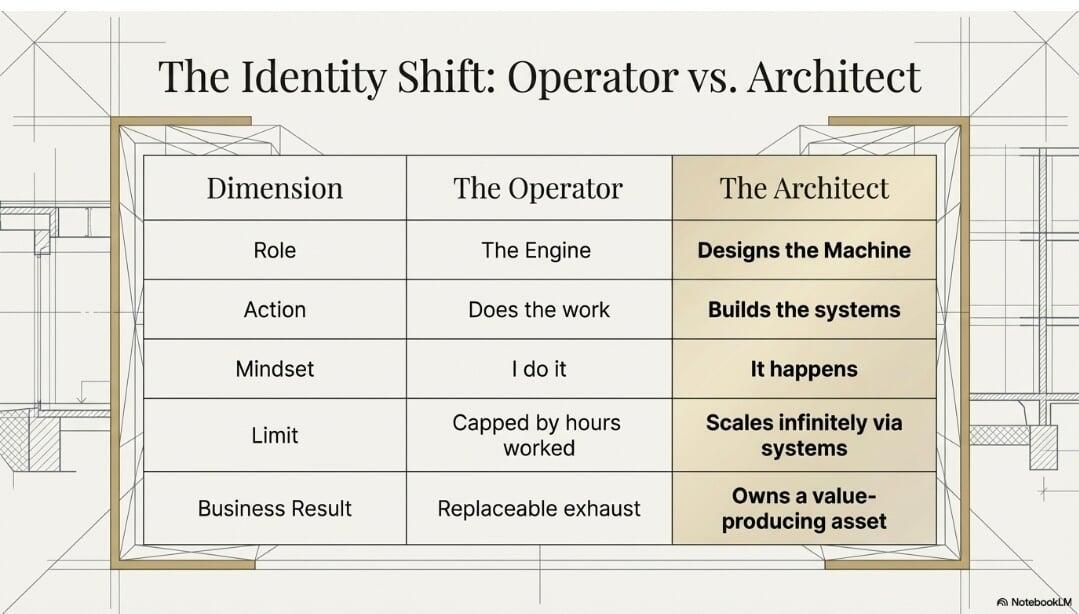
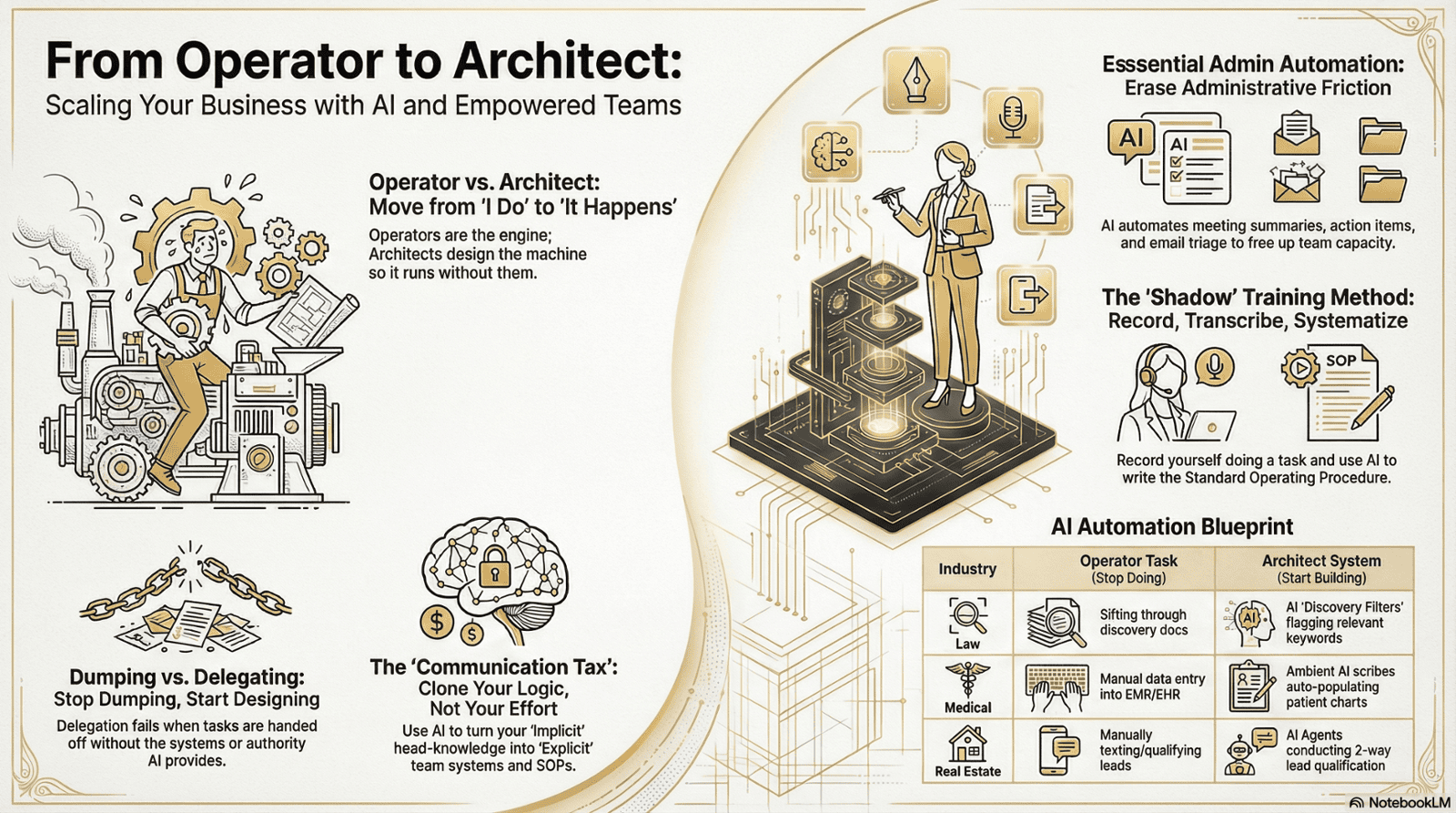
If you want to grow without burning out, you have to stop being the engine of your business and start designing the system that runs the engine. In the world of scale, this is known as the transition from Operator to Architect.
Here is exactly how you can make that transition, build an empowered team, and leverage Artificial Intelligence (AI) to scale your operations.
The Lie Keeping You Stuck in "Survival Mode"
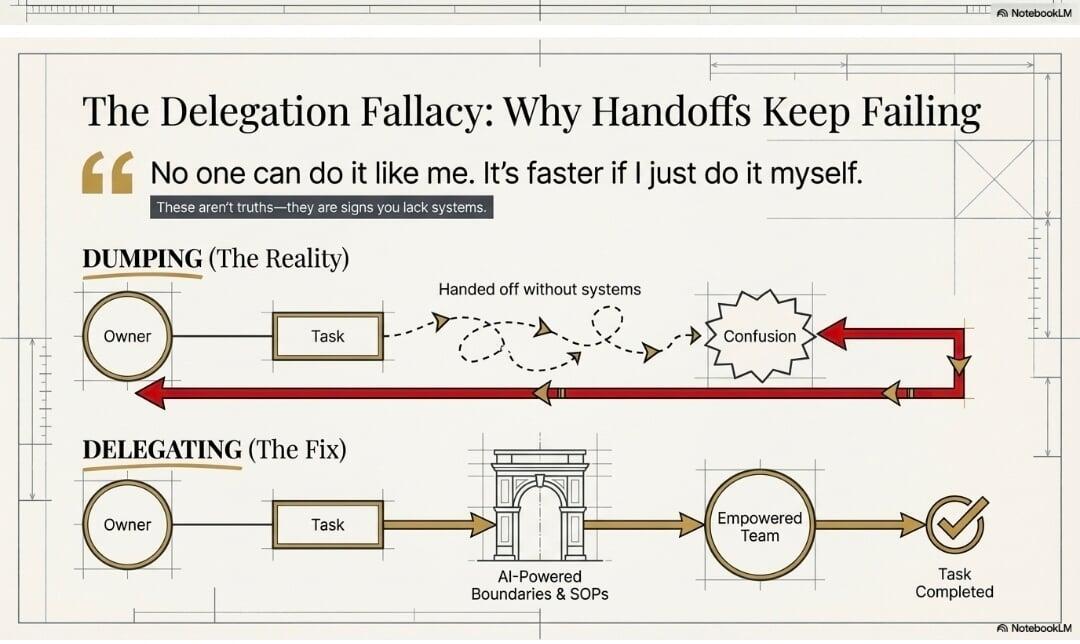
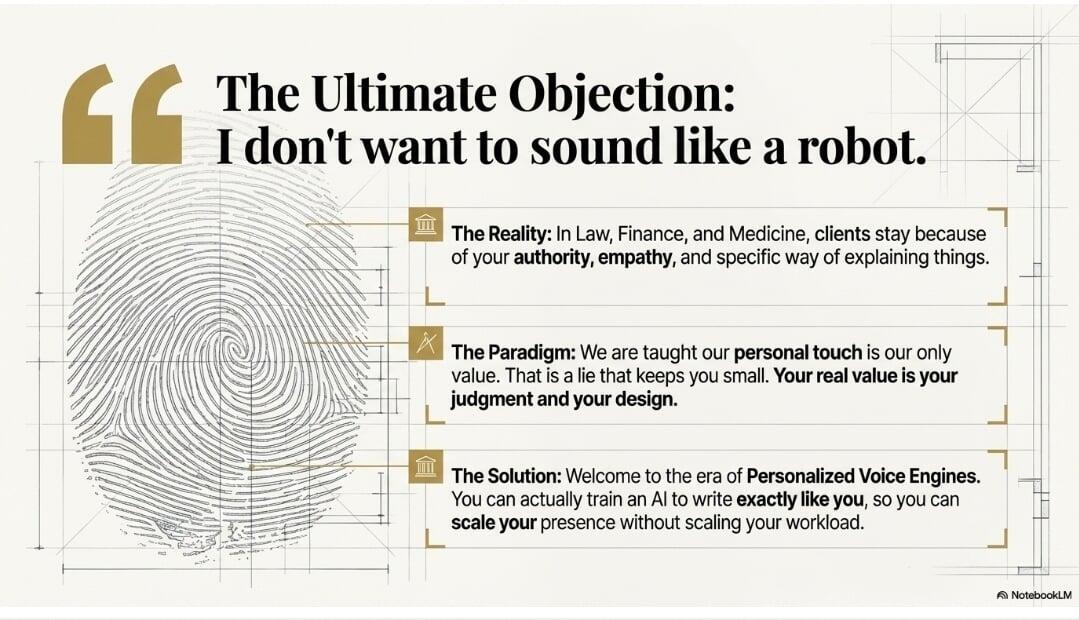
The first step to escaping the daily grind is changing your mindset. In many high-trust industries, we are taught that our personal touch is our only real value. We tell ourselves, “No one can do it like me,” or “It’s faster if I do it”.
These aren't truths; they are lies that keep your business small and signal a severe lack of internal systems. Your actual value lies in your judgment and your ability to design a functioning business. Right now, if you are the one answering every high-level email, reviewing minor documents, and acting as the "hero" who has to save every deal, you are stuck operating in survival mode. An Operator's income will always be capped by the hours they can work. An Architect, on the other hand, designs a machine that runs whether they are in the office or on a beach in Cabo.
Stop Dumping and Start Delegating
To break free from this bottleneck, you need to build an empowered team. But why do so many business owners fail at delegation?
Usually, it is because you aren't actually delegating—you’re just "dumping" tasks.
Delegation completely fails when tasks are handed off to employees without clear expectations, authority, or supporting systems. Without clarity, tasks create confusion and bottlenecks, inevitably looping right back to your desk. An empowered team operates entirely differently. They have the structure in place to execute tasks without asking for permission, make decisions within defined boundaries, and actively solve problems. This level of autonomy does not come from motivational pep talks; it comes from rock-solid systems.
Using AI to Fix the "Communication Tax"
The biggest headache for any small business owner attempting to build these systems is team communication. It often feels like you have to repeat yourself a thousand times just to get something done right.
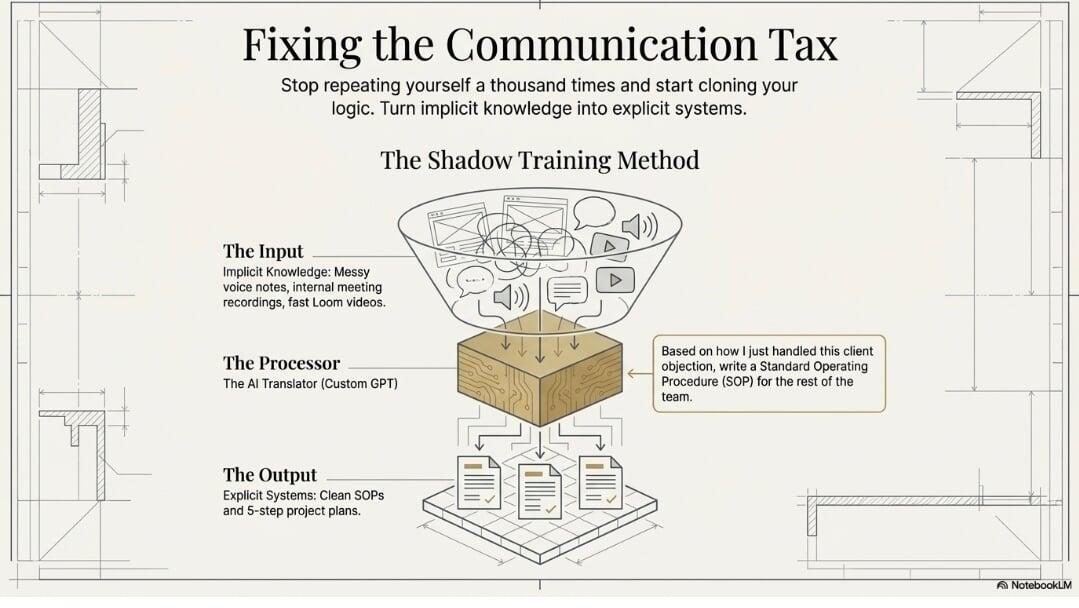
In modern business, you shouldn’t be repeating yourself; you should be using AI to clone your logic. AI can massively improve your team communication by turning your "implicit" knowledge (the secret sauce currently stuck in your head) into "explicit" systems.
Here are three powerful ways to use AI to improve internal communication and culture:
The "Shadow" Training Method: Record your internal meetings or use Loom videos to capture yourself performing a task. Feed that transcript into an AI like Gemini and prompt it: "Based on how I just handled this client objection, write a Standard Operating Procedure (SOP) for the rest of the team."
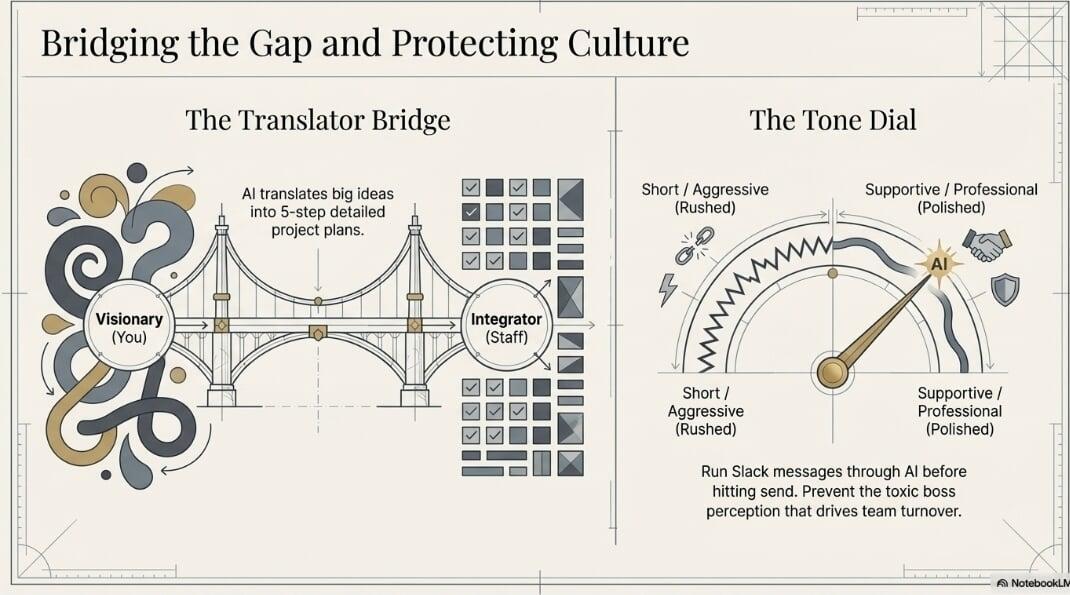
The AI "Translator": Entrepreneurs are often "Visionaries" who speak in messy, big ideas, while staff members are "Integrators" who desperately need details. You can use AI to bridge this gap by taking a rambling voice note and asking AI to "Translate this into a clear, 5-step project plan for my office manager."
Tone Checking for Team Culture: Communication isn't just about task management; it's about tone. If you run a high-stress medical or law office, your quick emails might come off as aggressive when you are simply busy. Running Slack messages through AI to ensure they sound supportive prevents the "toxic boss" perception that heavily contributes to employee turnover.
Specific Tasks AI Can Automate Right Now
You don't just have to use AI for internal communication; you can use it to automate daily workflows. AI helps automate tasks and removes the friction of repetition and organization.
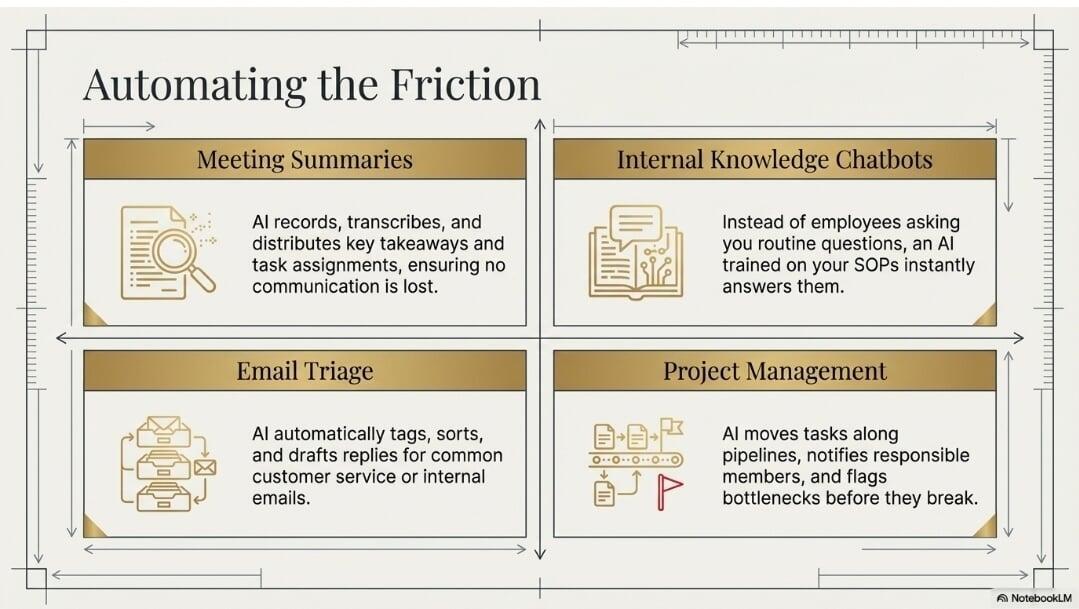
Here are specific, day-to-day tasks AI can automate to free up your team:
Meeting Summaries and Action Items: AI tools can record, transcribe, and automatically distribute key takeaways and task assignments from team meetings so no communication gets lost.
Internal Knowledge Base Chatbots: Instead of employees asking you how to do a routine process, an AI chatbot trained on your company's SOPs can instantly answer their questions.
Email and Inbox Triage: AI can automatically tag, sort, and draft replies for common internal team or customer service emails, significantly reducing organizational friction.
Project Management Automations: AI can notify the next responsible team member, move tasks along a pipeline, and flag bottlenecks before they become major issues.
Automating in "Your Voice" (Industry-Specific Examples)
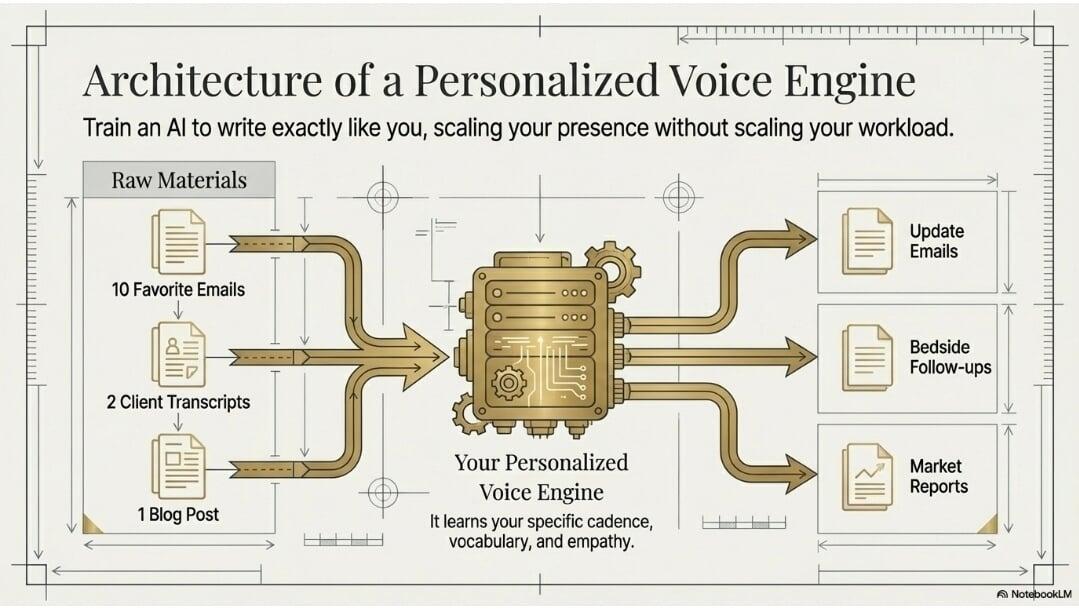
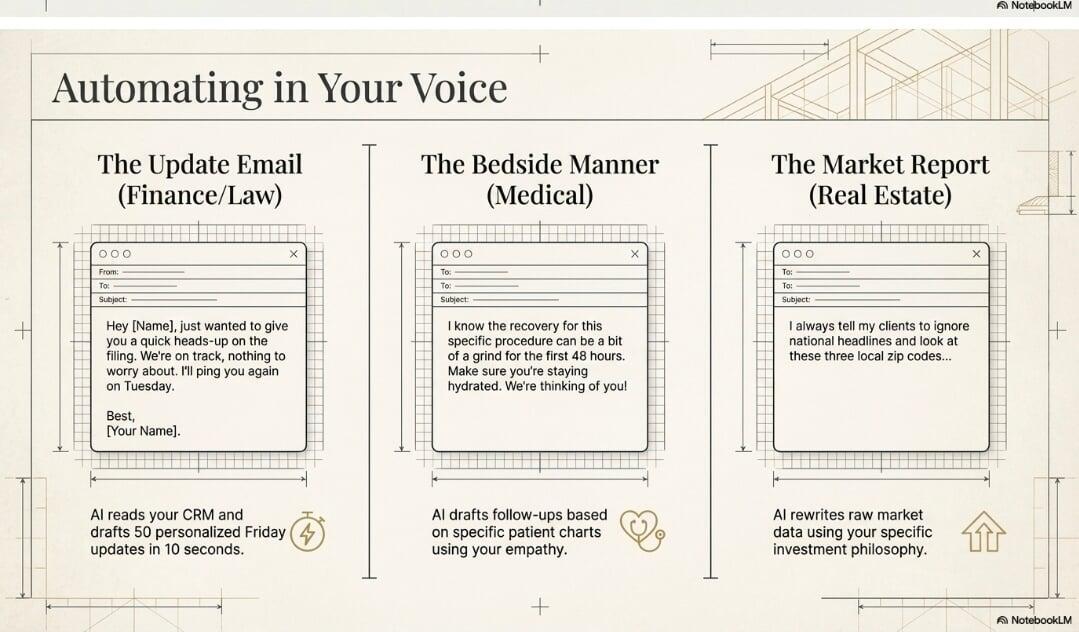
The biggest fear experts have when using AI is that they will start sounding like a robot to their clients. However, using "Personalized Voice Engines," you can train AI to write exactly like you, maintaining your authority, empathy, and specific vibe.
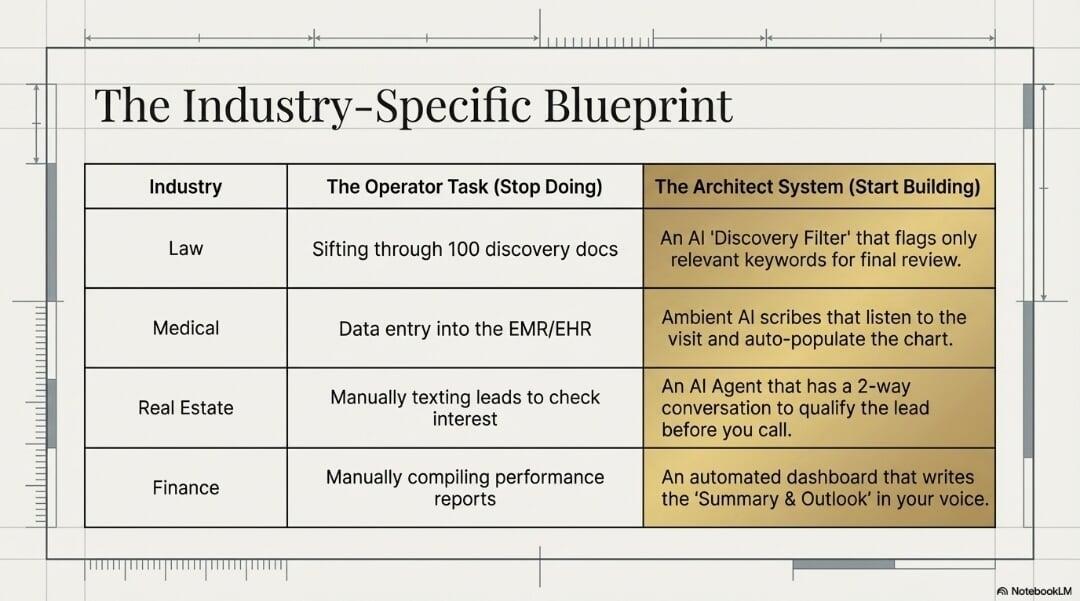
Here is what the shift from Operator to Architect looks like when you use AI to automate industry-specific tasks:
Law: Stop sifting through 100 discovery documents (Operator) and build an AI "Discovery Filter" that flags only relevant keywords for your review (Architect). You can also design a "Case Lifecycle" where AI intakes clients and drafts 80% of a motion, leaving you with just a 10-minute final review.
Medicine: Stop manual data entry (Operator) and use ambient AI scribes that listen to the patient visit and auto-populate the chart (Architect). AI can also draft a personalized "Bedside Manner" follow-up message based on a patient's specific chart, perfectly replicating your caring tone.
Real Estate: Stop manually texting leads to see if they are still interested (Operator) and implement an AI Agent that has a 2-way text conversation to qualify the lead before you ever call (Architect). You can also have AI rewrite generic market data into a high-end market report that reflects your personal investment philosophy.
Finance: Stop manually compiling quarterly performance reports (Operator) and use an automated dashboard that uses AI to write the "Summary & Outlook" in your specific voice (Architect).
How to Start the Transition This Week
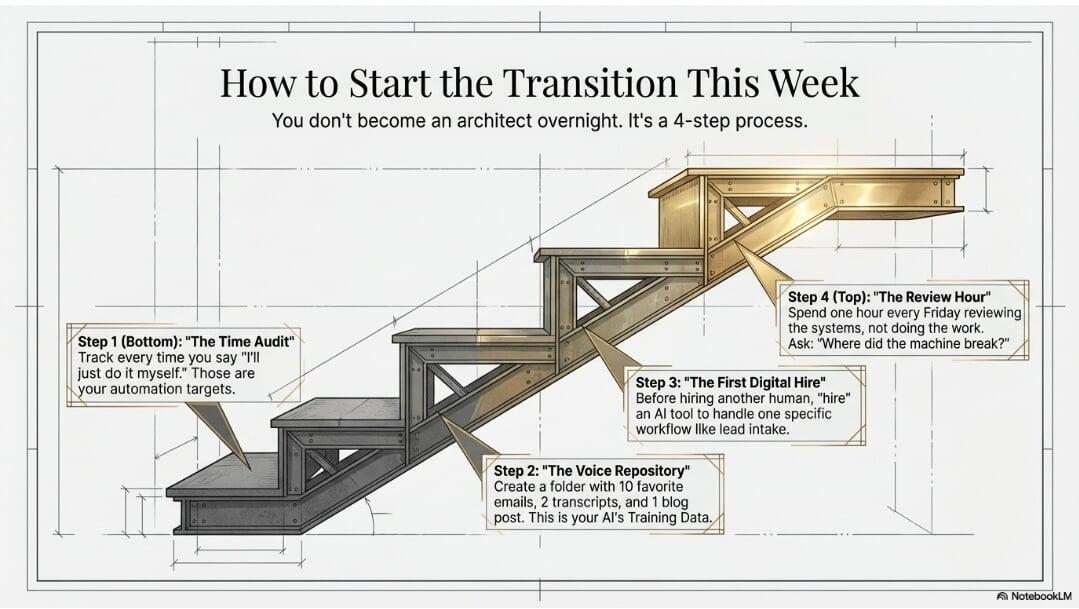
You don’t become an Architect overnight, but you can start the process this week by following these four steps:
1. The Time Audit: For one week, track every single time you say, "I'll just do it myself." These moments are your primary targets for automation.
2. The "Voice" Repository: Create a folder containing 10 of your best emails, two transcripts of you speaking to clients, and your favorite blog post. This becomes the "Training Data" so your AI can learn your style.
3. The First Hire (Digital): Before you hire another expensive human employee, "hire" an AI tool to handle one specific workflow, like client updates or lead intake.
4. The Review Hour: Spend one hour every Friday stepping away from daily work to review your new systems. Ask yourself: "Did the machine work this week? Where did it break?"
The Final Word
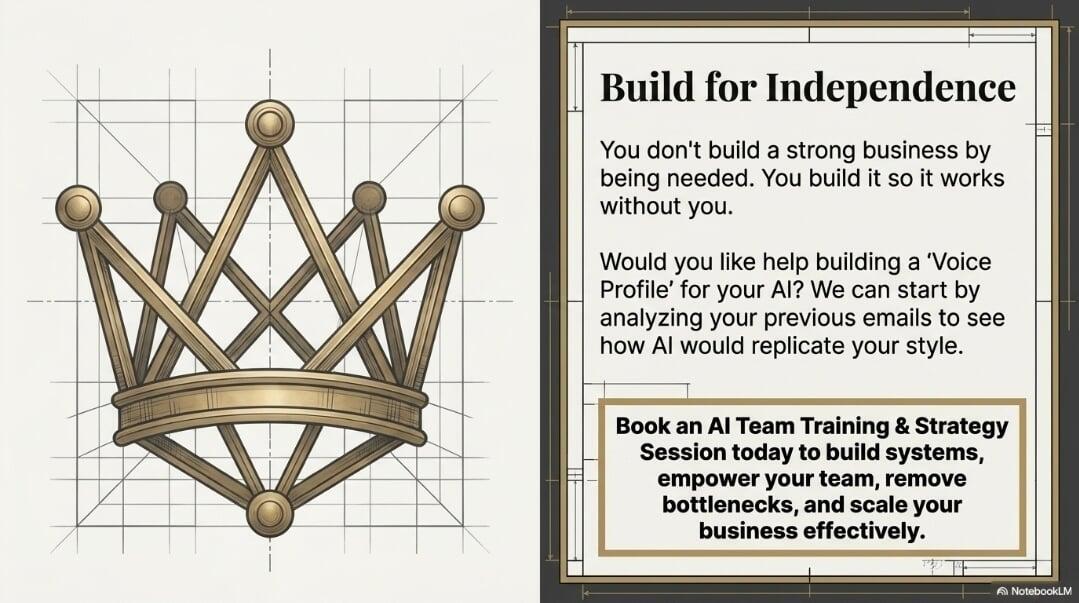
The gap between a $1M business and a $10M business isn't simply the number of employees you hire—it is the quality of your architecture. Operators are exhausted and replaceable. Architects are focused, and they own an asset that produces value even while they sleep. You don’t build a strong business by being needed; you build it so it works without you.