The Business Hierarchy of Needs
Every Entrepreneur Must Understand
Entrepreneurship is often sold as freedom. Freedom to build something meaningful. Freedom to control your income. Freedom to design your life. But behind the motivational posts and highlight reels is a truth every entrepreneur eventually faces.
Running a business is emotional. It is stressful. It can feel lonely. And sometimes it feels like you're trying to solve ten problems at once.
Many small business owners start asking the same question: Why does growing a business feel so hard?
The answer often lies in something most people first learn in psychology class: Maslow’s Hierarchy of Needs.
Understanding this original concept helps us understand something powerful about business growth. Businesses, much like humans, have fundamental needs that must be met before they can grow and thrive.
What Is Maslow’s Hierarchy of Needs?
Maslow’s Hierarchy of Needs is a psychological theory developed by the American psychologist Abraham Maslow in 1943.
Maslow proposed that human beings are motivated by different levels of needs, which build upon each other in a structured hierarchy. These needs are often visualized as a pyramid.
The idea is simple but powerful:
Higher-level needs cannot be fully pursued until lower-level needs are satisfied.
For example, if someone is struggling to find food or shelter, they are unlikely to focus on creativity, personal growth, or purpose.
Maslow identified five levels of human needs.
1. Physiological Needs
These are the basic requirements for survival.
They include: food, water, shelter, sleep, physical health
Without these necessities, the human body cannot function properly. These are the foundation of the entire hierarchy.
2. Safety Needs
Once survival needs are met, people begin seeking stability and protection.
Safety needs include: financial security, personal safety, health stability, stable employment, safe environments
At this stage, individuals want predictability and protection from chaos.
3. Love and Belonging
Humans are social creatures. After safety is established, people seek connection and relationships.
These needs include: friendships, family relationships, community, emotional connection, acceptance
Belonging plays a powerful role in emotional well-being and motivation.
4. Esteem Needs
At this level, individuals pursue confidence, recognition, and achievement.
Esteem needs include: respect from others, personal accomplishment, reputation, status, recognition
People want to feel capable, valued, and respected.
5. Self-Actualization
At the top of Maslow’s pyramid is self-actualization. This is the pursuit of personal fulfillment and purpose.
Self-actualization includes: creativity, personal growth, pursuing passions, reaching one's full potential
When individuals reach this stage, they are motivated not just by survival, but by meaning and impact.
What Maslow’s Hierarchy Reveals About Human Behavior
Maslow’s theory teaches us something important. Human motivation is not random.
- People focus on the needs that matter most for their current stage of life.
- Someone worried about paying rent is not thinking about legacy.
- Someone searching for safety is not focused on public recognition.
- Each stage builds upon the previous one.
This insight does not only apply to people. It also applies remarkably well to business.
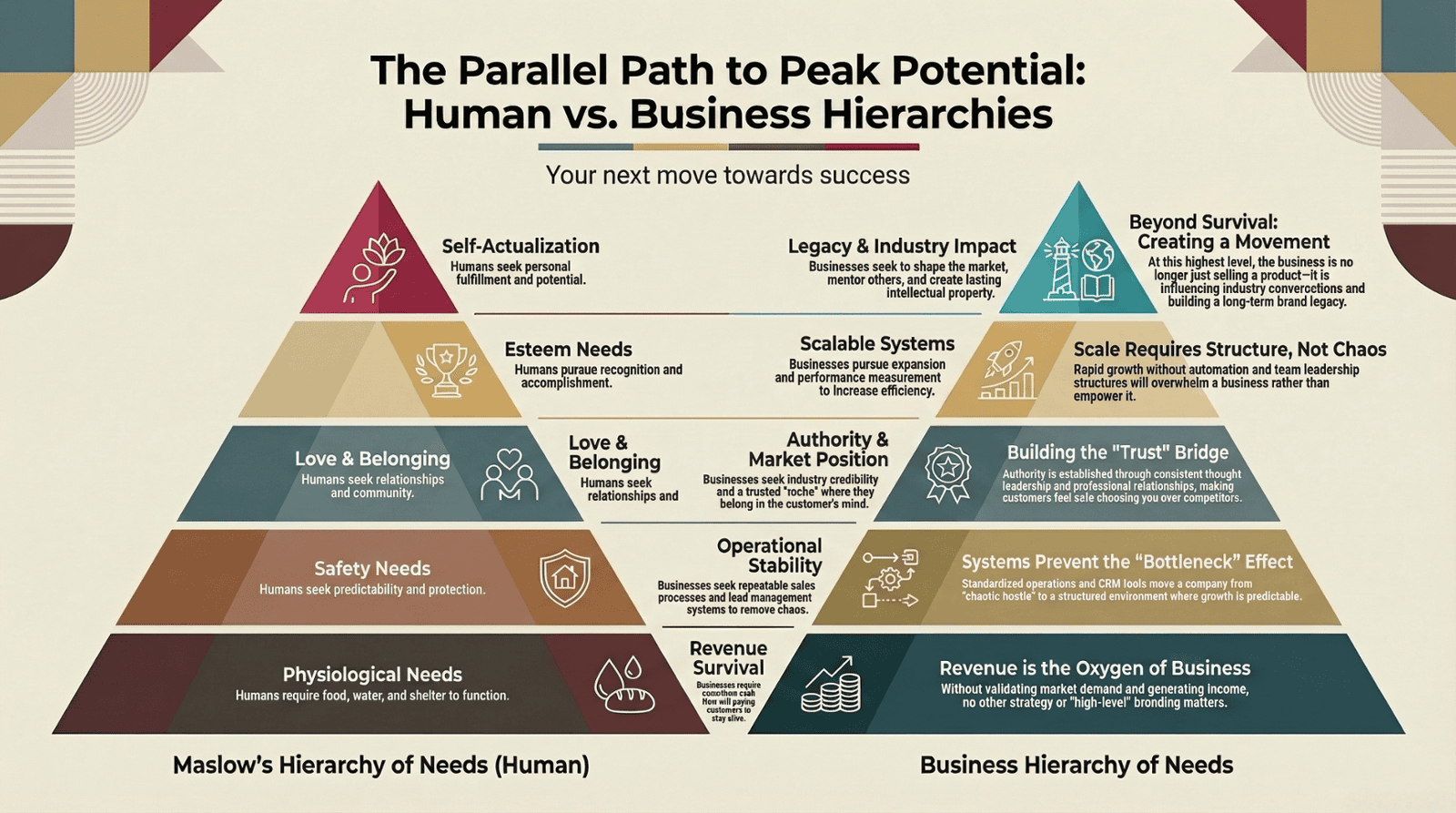
The Business Hierarchy of Needs
Just like people, businesses have essential needs that must be satisfied in order.
If a business tries to pursue higher-level strategies before meeting its foundational needs, growth becomes unstable.
- Marketing fails.
- Scaling fails.
- Even strong ideas collapse under pressure.
Understanding the business hierarchy of needs helps entrepreneurs build companies step by step instead of jumping ahead too quickly.
Level 1: Revenue Survival
The physiological need of business
The first need of every business is revenue. Without consistent income, a business cannot survive.
At this stage, the focus must be on:
- generating paying customers
- validating the product or service
- identifying market demand
- building a clear and valuable offer
This stage often feels intense for entrepreneurs. There may be fear, uncertainty, and constant pressure to produce results.
But this phase is critical. Revenue is the oxygen that keeps a business alive. Without it, no other strategy matters.
Level 2: Operational Stability
The safety layer of business. Once revenue exists, the next need becomes stability.
Businesses must move from chaotic hustle to structured operations.
This includes:
- repeatable sales processes
- clear offers and pricing
- customer tracking systems
- lead management and CRM tools
- consistent messaging
Without operational stability, businesses experience unpredictable growth. Sales spike one month and disappear the next.
The owner becomes the bottleneck for everything. Establishing systems creates the safety that allows a business to grow with confidence.
Level 3: Authority and Market Position
The belonging layer of business. Once stability is created, businesses must establish their place in the market.
Customers begin asking an important question: Why should we trust you?
This is where authority and brand positioning become critical.
- Businesses must build:
- industry credibility
- consistent content and thought leadership
- trust through expertise
- strong professional relationships
- visibility within their niche
Authority builds familiarity and confidence in the marketplace.
It allows customers to feel comfortable choosing your business over competitors.
Level 4: Scalable Systems
The esteem stage of business growth At this stage, the business seeks expansion and recognition.
Growth becomes the priority. However, scaling requires systems.
Businesses must develop:
- automation processes
- operational procedures
- team leadership structures
- scalable marketing systems
- performance measurement tools
Without these systems, rapid growth can overwhelm a business. Scaling should increase efficiency, not chaos.
Level 5: Legacy and Industry Impact
The self-actualization stage of business. At the highest level, the business reaches influence and long-term impact.
The company is no longer focused solely on survival or growth. It begins shaping the market itself.
This stage includes:
- building a powerful brand
- creating intellectual property
- influencing industry conversations
- mentoring other entrepreneurs
- establishing long-term legacy
Businesses operating at this level often create communities, movements, and lasting change within their industries.
Why Many Small Businesses Struggle to Grow
Many entrepreneurs attempt to jump directly into advanced strategies.
They invest heavily in:
- marketing campaigns
- social media growth
- advertising
- branding
But if the foundational layers are weak, these efforts rarely produce lasting results.
Growth strategies only work when the business foundation is strong.
Skipping steps often leads to frustration, burnout, and financial stress.
Understanding Where Your Business Stands
Every business is operating somewhere within this hierarchy.
Identifying your stage is one of the most valuable exercises an entrepreneur can do.
Ask yourself:
Is my revenue consistent?
Are my operations stable and repeatable?
Is my brand recognized and trusted?
Do I have systems that support scaling?
Am I building long-term impact?
The answers reveal the next strategic move your business needs to make.
The Strategic Path Forward
Businesses do not grow randomly. They grow through stages.
- Revenue
- Stability
- Authority
- Scale
- Legacy
When entrepreneurs understand these stages, they stop chasing scattered tactics and start building intentional growth strategies.
And when each level of the hierarchy is satisfied, business growth becomes not only possible, but sustainable.
Because every successful company, just like every successful person, must build its foundation before reaching its full potential.