And Your Business Is Paying for That Silence Every Single Day
There's a specific kind of frustration that hits revenue-generating business owners differently than everyone else.
It's not the frustration of failure. You've already proven the demand. Customers have already paid you. The market has already told you the idea works.
It's the frustration of a business that works — but only when you work. The moment you step back, growth stalls. The moment you stop pushing, the pipeline dries up. You've built something real, but somewhere between proving the concept and scaling the operation, the engine stopped and you became the engine.
In chess, a passed pawn has outlasted every opposing piece between it and the other side of the board. No opposition can stop it. The path is clear. But it doesn't advance on its own — it needs to be pushed. Until it is, all that potential sits dormant. One move away from becoming unstoppable. That's your business right now. |
You're not stuck because you failed. You're stuck because nobody has shown you how to advance. And one of the biggest reasons your revenue isn't moving the way it should? Your offers aren't creating tension. They're creating options. And options, in a distracted market full of skeptical buyers, get ignored. Let's fix that.
First, Let's Name What's Actually Broken
Before we get into offer strategy, let's be precise about the real problem — because surface-level diagnosis leads to surface-level solutions, and you've already wasted enough money on those.
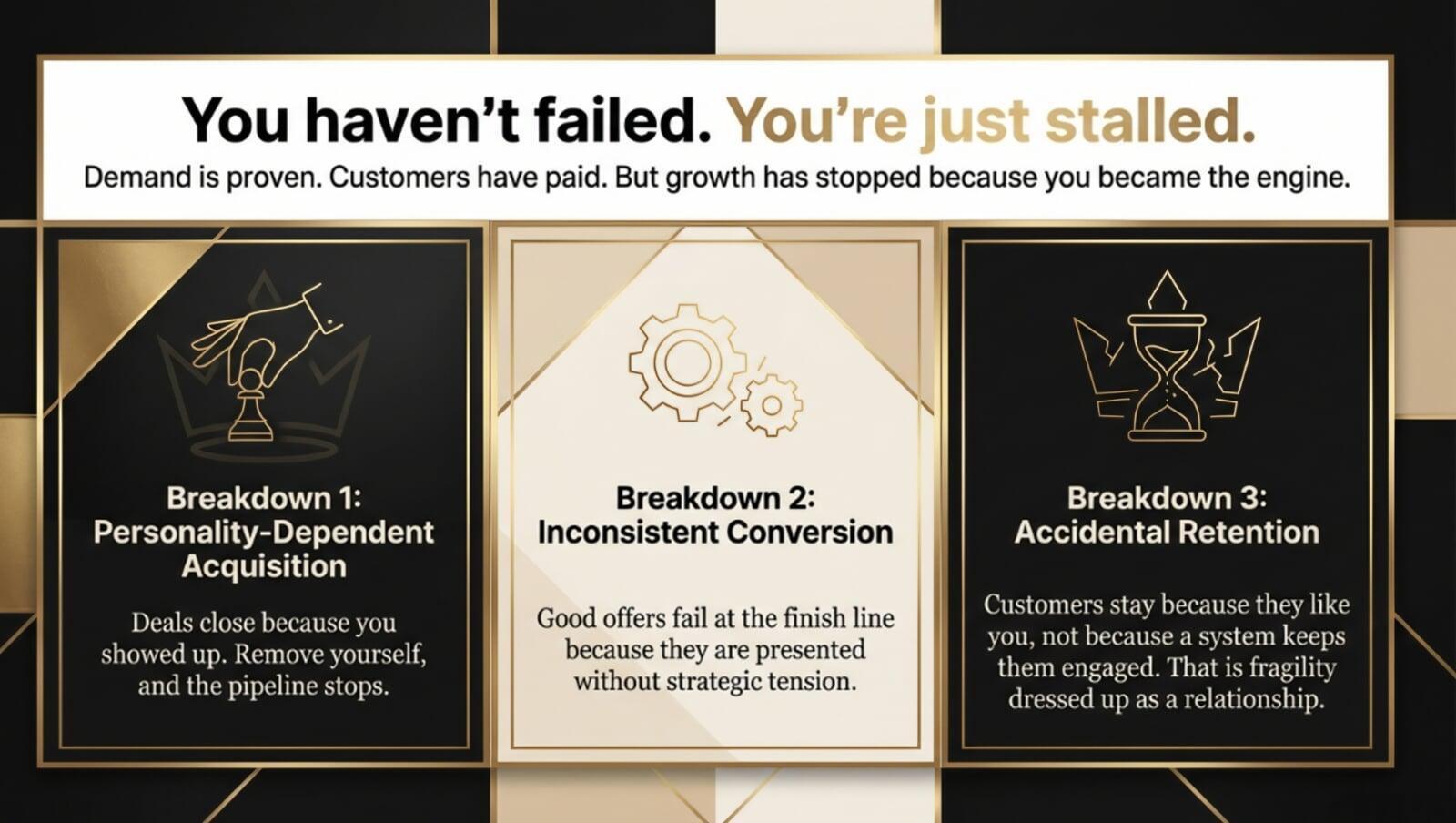
Most business owners with proven demand but stalled growth share three structural breakdowns:
Breakdown #1: Customer acquisition is personality-dependent, not system-dependent. Deals close because you showed up, followed up, or made the call. Remove you from the equation and the pipeline doesn't just slow — it stops.
Breakdown #2: Conversion is inconsistent because the offer isn't engineered. Your offer might be good. But good offers presented without strategic tension don't convert at the rate they should. You're leaving revenue on the table every single week not because the market doesn't want what you have, but because your messaging doesn't make them feel the cost of waiting.
Breakdown #3: Retention is accidental, not architected. Customers stay because they like you, not because a system keeps them engaged, delivers consistent value, and proactively reduces churn. That's not loyalty — that's fragility dressed up as relationship.
These three breakdowns compound. And they all share a common root: the absence of a revenue system that operates independently of your daily involvement.
At Passed Pawn Premier Strategies, we don't run marketing campaigns. We build fully integrated revenue operations systems — business development, conversion architecture, and AI-powered automation working as one engine — that advance your business even when you step away from the board. |
But before any system can work, your offer has to create the right conditions for a decision. And right now, most of your offers are creating the worst possible condition: Comfort.
Why Comfort Is the Enemy of Conversion
Here's something counterintuitive that most marketing consultants won't tell you because it makes their job harder:
The more comfortable your offer makes someone feel about not deciding, the less likely they are to buy.
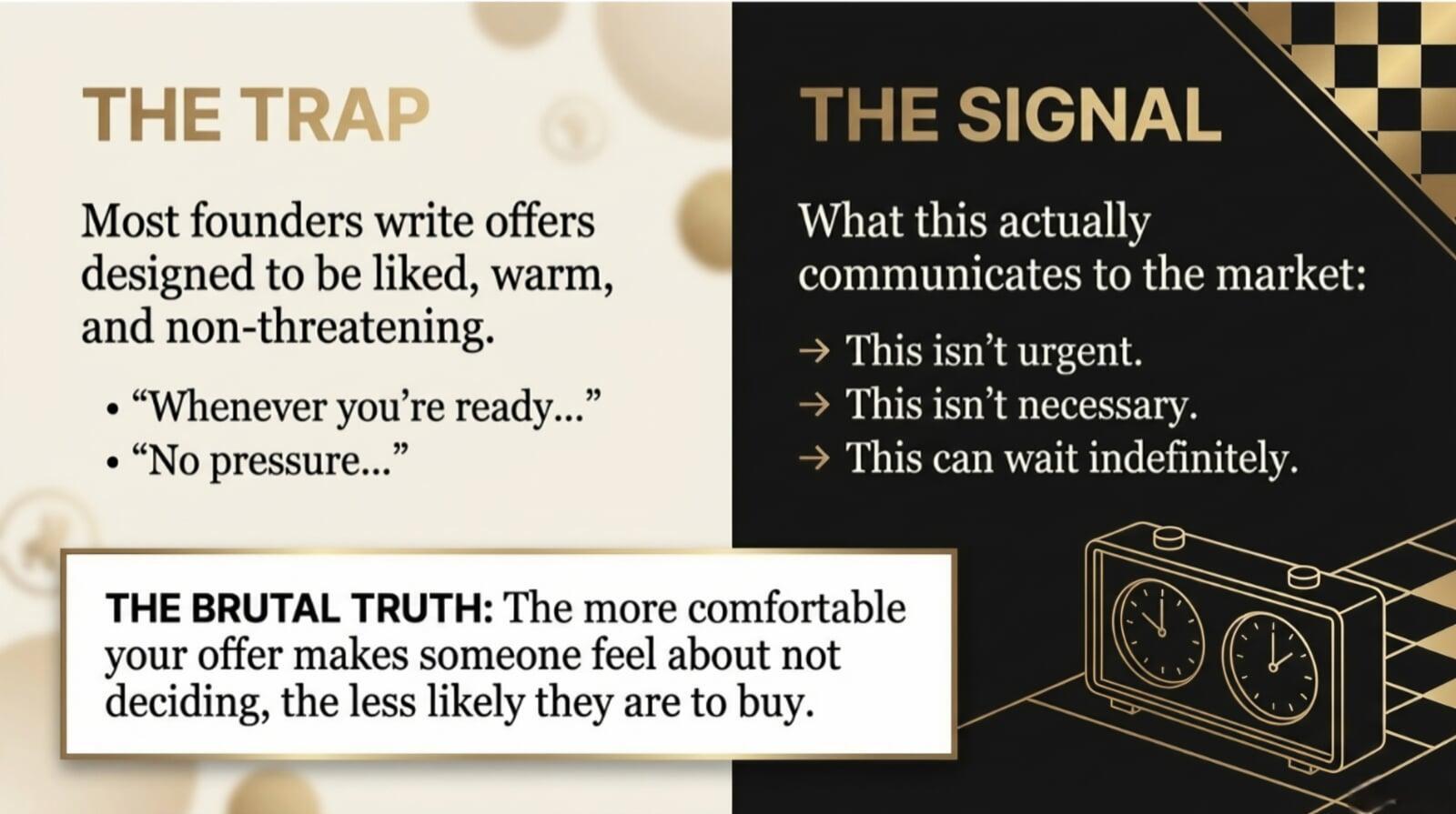
Most business owners write offers designed to be liked. Warm. Approachable. Non-threatening.
"Whenever you're ready…"
"This could be a great fit for some of you…"
"No pressure — just reach out if you want to chat…"
Read that language again. What does it actually communicate?
→ This isn't urgent.
→ This isn't necessary.
→ This can absolutely wait.
And here's the brutal truth about things that can wait: they get waited on indefinitely. Your ideal client — the overextended founder who is skeptical of traditional marketing, has been burned before, and is highly selective about where they invest — does not respond to soft language. They respond to clarity, specificity, and stakes.
Strategic Tension: The Missing Variable in Your Revenue Equation
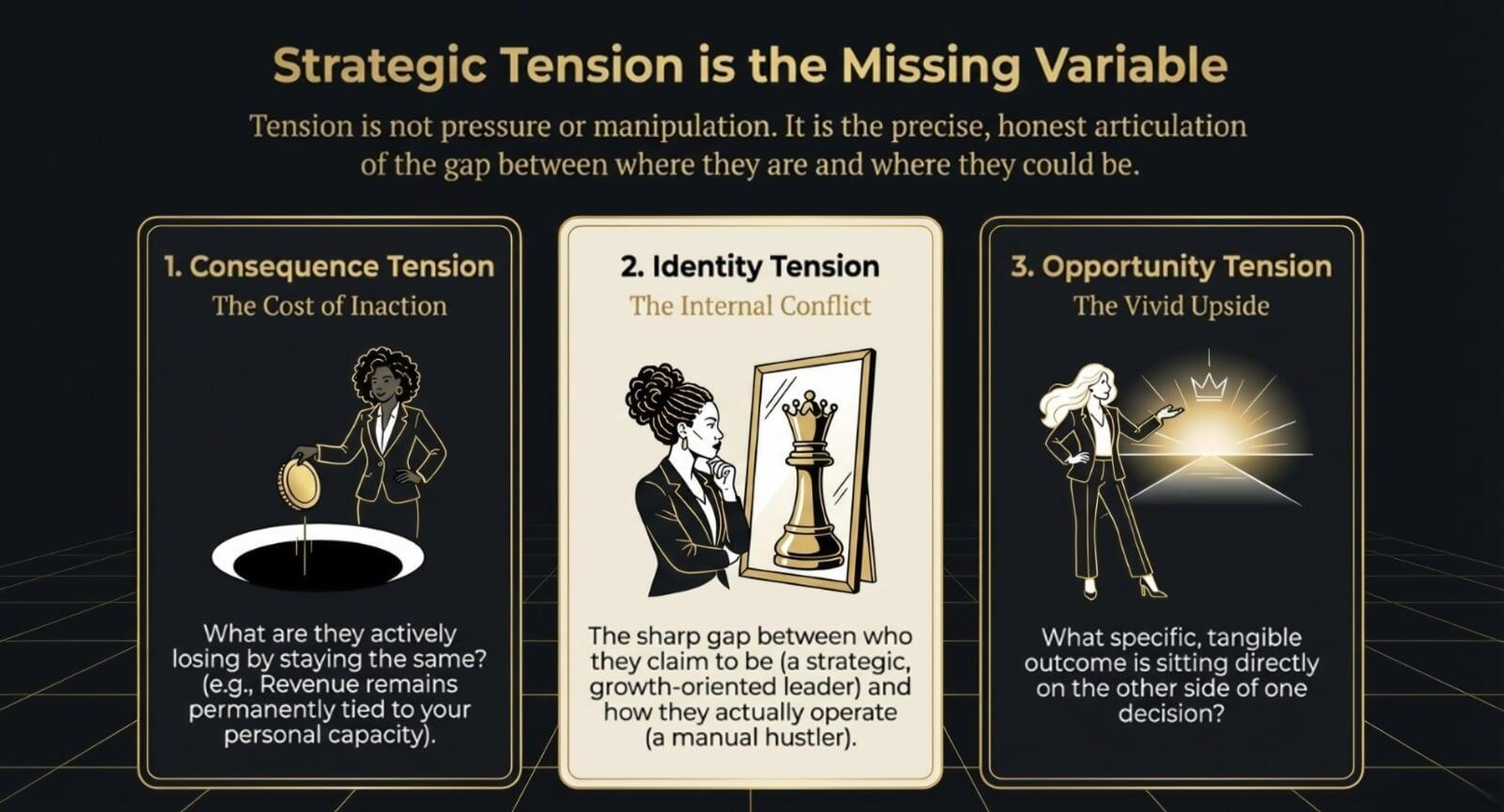
Strategic tension is not pressure. It's not manipulation. It's not a countdown timer that resets every 24 hours. Strategic tension is the precise, honest articulation of three things:
1. Where your client is right now
2. What it is actually costing them to stay there
3. What specifically becomes possible the moment they decide to move
Your job is not to convince people. Convincing is exhausting, unscalable, and attracts the wrong clients anyway. Your job is to make the gap between where they are and where they could be impossible to ignore.
There are three types of strategic tension that drive real purchasing decisions:
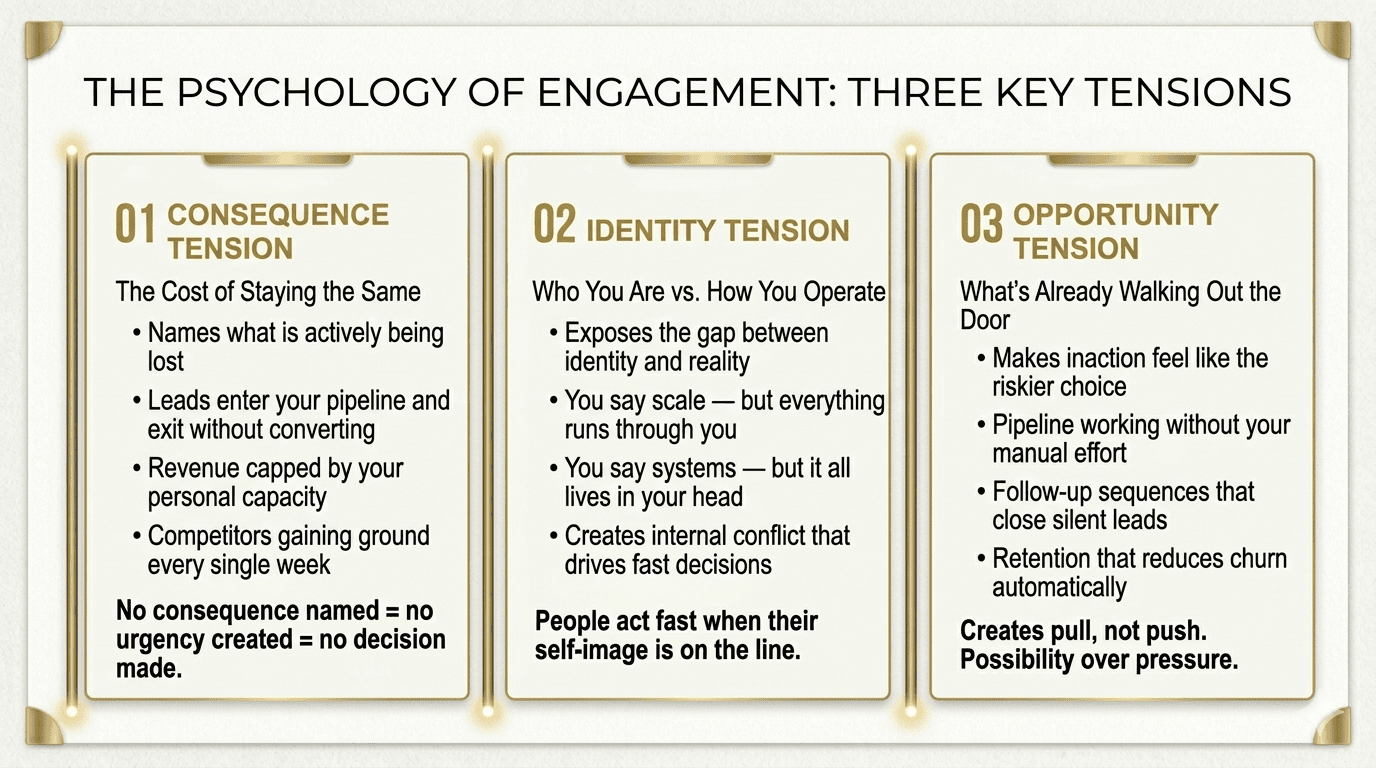
Tension Type #1: Consequence Tension — The Real Cost of Staying the Same
Most offers are benefit-heavy and consequence-free. They tell you everything you gain and nothing about what you keep losing by not acting. That's a critical strategic error.
What happens if nothing changes in the next 90 days?
Leads keep entering a pipeline with no real follow-up system and exit without converting
Revenue stays tied to your personal effort — which means your income has a ceiling called your capacity
Every week without a retention system is another week a competitor is quietly building loyalty with customers you already earned
No consequence named = no urgency created = no decision made. |
Tension Type #2: Identity Tension — The Gap Between Who They Are and How They're Operating
This is the sharpest tension type. Used correctly, it creates immediate internal conflict that accelerates decisions faster than any discount or deadline.
Your ideal client identifies as a strategic, growth-oriented business owner. They have ambition. They have standards. They have a vision of where their business is going.
And then there's the reality of how they're actually operating:
You say you want predictable revenue — but your follow-up process is "I'll remember to circle back."
You say you want to scale — but your entire operation depends on your personal involvement in every stage of the customer journey.
You say you want systems — but everything still lives in your head, your inbox, and a spreadsheet someone built three years ago.
That gap — between the identity they claim and the operation they're running — creates friction. Real friction. Identity tension isn't an attack. It's a mirror. The right people will recognize themselves and respect you for having the clarity to name it.
Tension Type #3: Opportunity Tension — What's Already Walking Out the Door
Unlike consequence tension, which focuses on the cost of inaction, opportunity tension focuses on the specific upside sitting right on the other side of one decision. This creates pull instead of push.
What does your business look like with a real acquisition system in place?
New customer conversations happening consistently without you manually generating every one A follow-up sequence that closes deals you would have previously lost to silence
A retention system that keeps clients engaged and reduces churn without a personal phone call every time
Opportunity tension makes the upside vivid and specific enough that not acting starts to feel like the riskier choice.
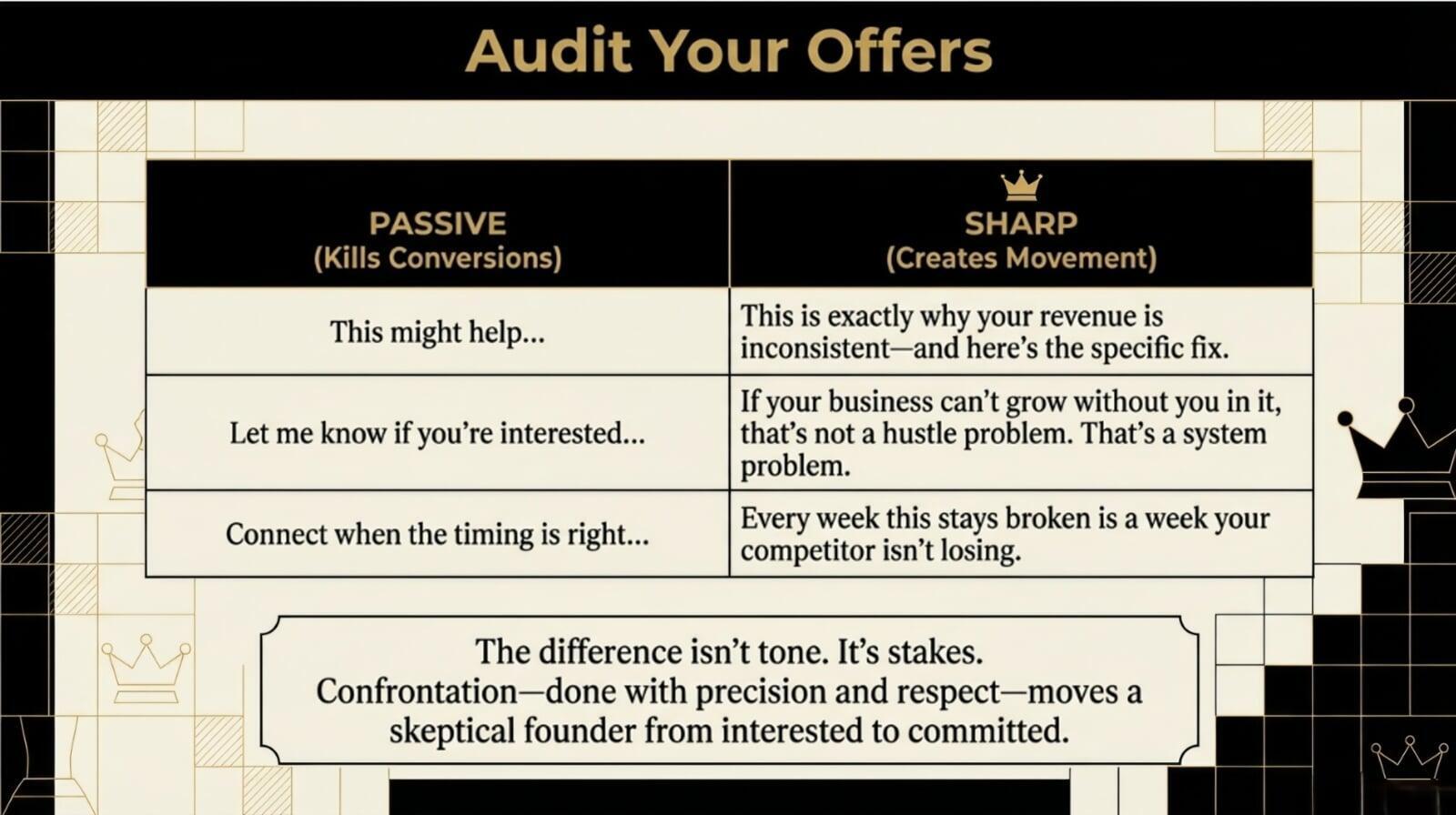
The Language Audit Your Offers Desperately Need
Pull up your current offer copy — your website, your last email campaign, your pitch deck. Run it through these filters:
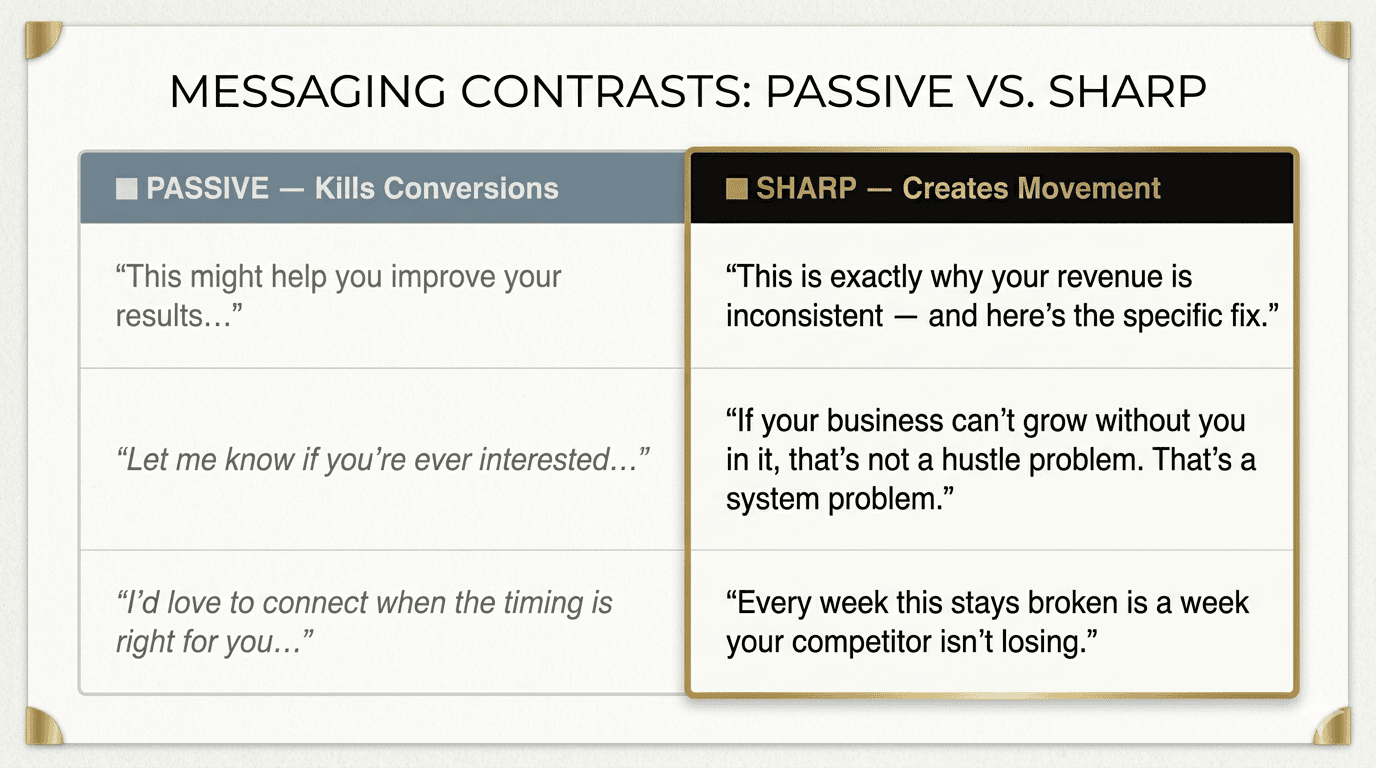
The difference isn't tone. It's stakes. One version describes. The other confronts. And confrontation — done with precision and respect — is what moves a skeptical, experienced founder from interested to committed.
Where AI Changes Everything (When Used With Strategic Intent)
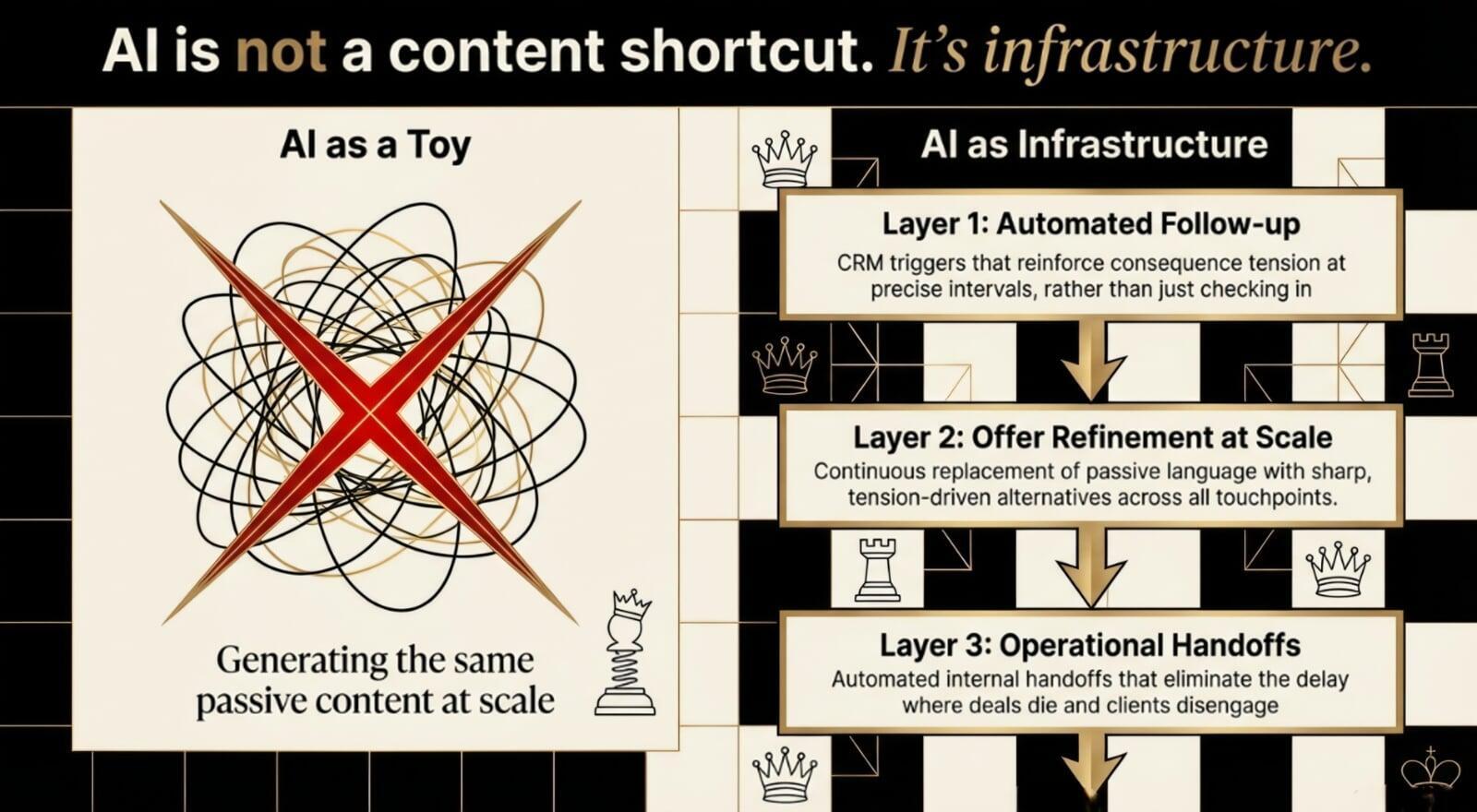
Let's address something directly: AI is not a content shortcut. Every business owner with a ChatGPT subscription is generating content right now. Most of it sounds exactly the same and converts at roughly the same rate as saying nothing.
AI becomes a genuine competitive advantage only when it's integrated into a revenue system with strategic intent behind every automation. Here's what that actually looks like:
Automated tension-driven follow-up:
CRM-triggered sequences that don't just "check in" but reinforce consequence and opportunity tension at precisely timed intervals. A lead who went quiet four days ago doesn't need a nudge — they need a message that names what their silence is costing them and opens a specific door back into the conversation.
Offer language refinement at scale:
AI-assisted copy analysis that identifies passive, consequence-free language in your existing offers and replaces it with sharp, tension-driven alternatives — consistently, across every touchpoint.
Operational communication that eliminates delay:
AI summaries of client interactions, automated internal handoffs, clear task assignment with accountability built in. Because delay — between marketing and sales, between sales and delivery, between delivery and retention — is where deals die and clients disengage.
At Passed Pawn Premier Strategies, AI integration isn't a feature we offer. It's infrastructure we build into the revenue system itself — so your business advances consistently, with or without you pushing every piece manually. |
The Passed Pawn Principle Applied to Your Offer Strategy
Here's the strategic thread that ties everything together:
A passed pawn has already done the hard work. It survived the opening chaos, outlasted the competition, and earned its position on the board. The only thing standing between it and full power is advancement — the right move, at the right moment, with the right strategy behind it.
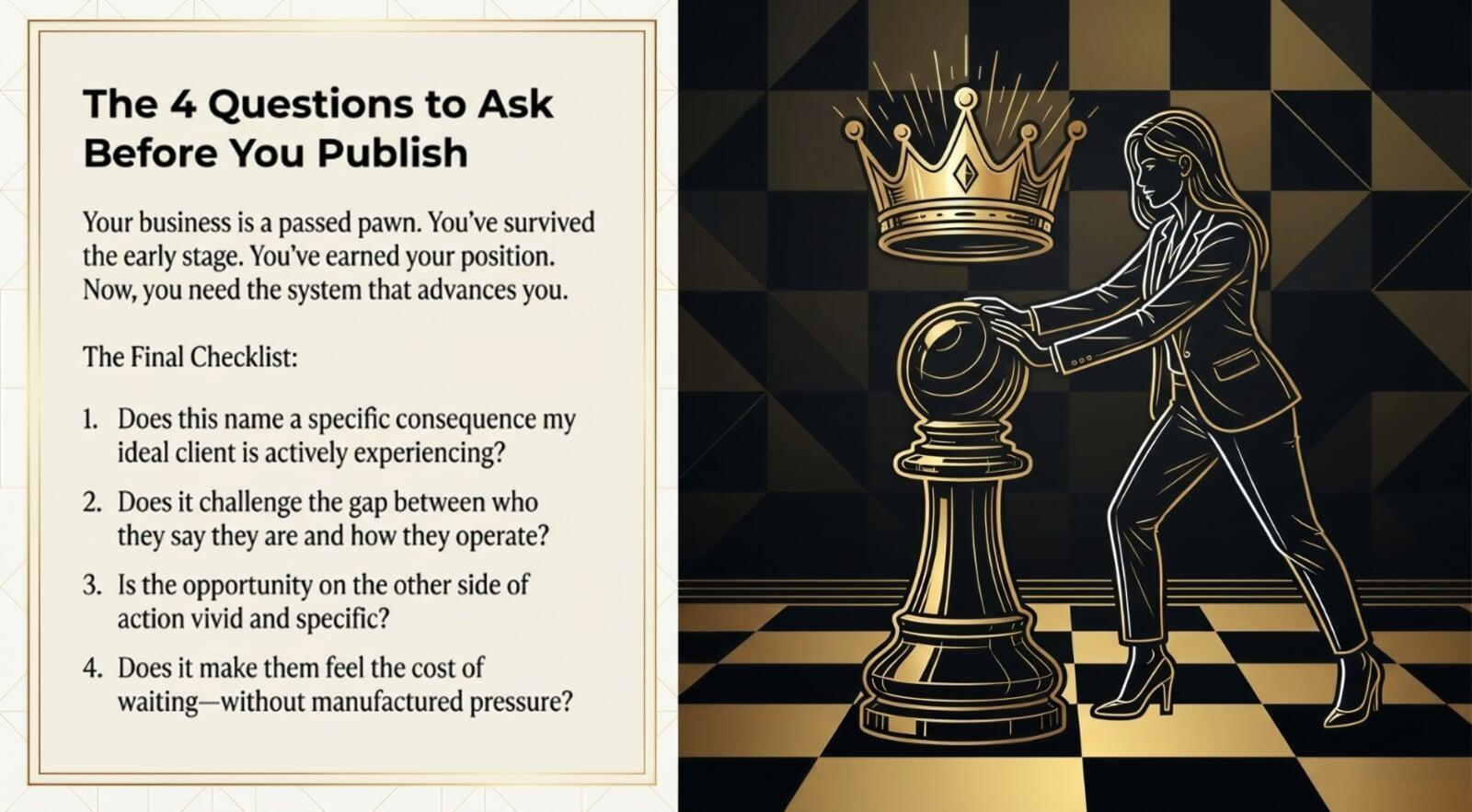
Your business is that passed pawn. You've proven demand. You've survived the early stage. You've earned your position. What you haven't built yet is the system that advances you consistently — that converts attention into revenue, effort into repeatable outcomes, and your role from overwhelmed operator to strategic architect. Your offer is the first move in that advancement. And right now, it's sitting still. Strategic tension is what moves it forward. |
Before You Publish Another Offer, Ask These Four Questions
1. Does this name a specific consequence my ideal client is actively experiencing?
2. Does this challenge the gap between who they say they are and how they're actually operating?
3. Does this make the opportunity on the other side of action vivid and specific?
4. Does this make someone feel the cost of waiting — without manufactured pressure?
If the answer to any of those is no, rewrite before you publish. Because a safe offer gets ignored. A sharp offer gets attention. A tension-driven offer, backed by a real revenue system, gets sales — predictably, repeatably, and at scale. That's not a promise. That's engineering.
The Bottom Line
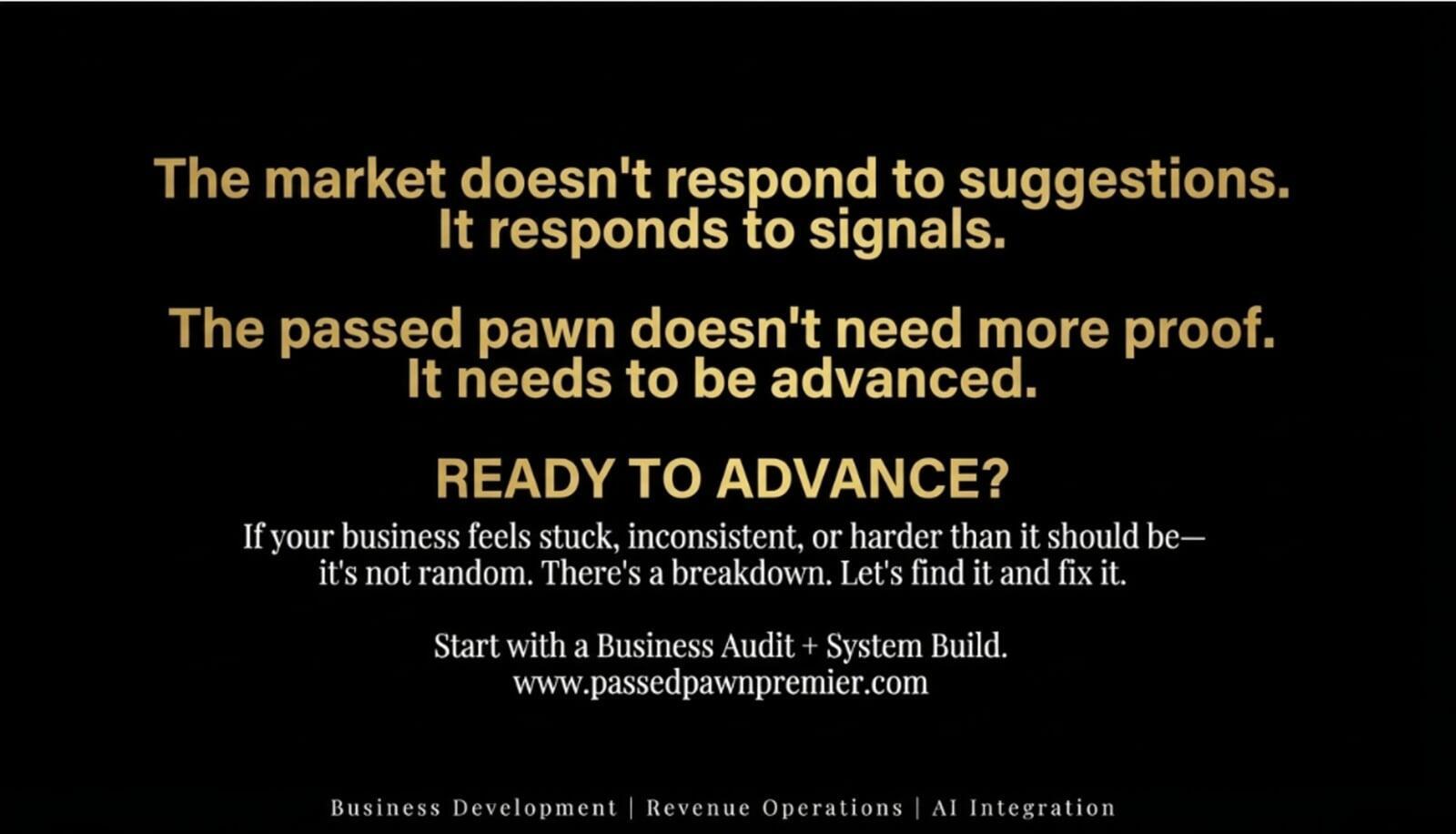
Your offer is currently sitting in the market like a polite suggestion from someone who doesn't want to impose. The market doesn't respond to suggestions. It responds to signals — clear, specific, high-stakes signals that make your exact client stop and say: this is what I've been dealing with, and I need to fix it now. You've already proven your business works. Now it's time to build the system that makes it advance — with or without you pushing every piece by hand.
The passed pawn doesn't need more proof. It needs to be advanced.