Mastering Structural Growth
The Blind Spots Costing Your Business More Than You Think
You can’t see your own blind spots. Not because you lack intelligence but because familiarity creates distortion.
Every founder believes they understand their business clearly. Yet businesses plateau every day. Revenue stalls. Marketing loses traction. Growth slows without a dramatic event. It rarely collapses. It drifts. Drift is expensive.
If you’re wondering why your business has plateaued, or why your growth strategy for small business feels reactive instead of predictable, the issue is rarely effort. It’s structural.
A Real Example: The $8,000 Blind Spot
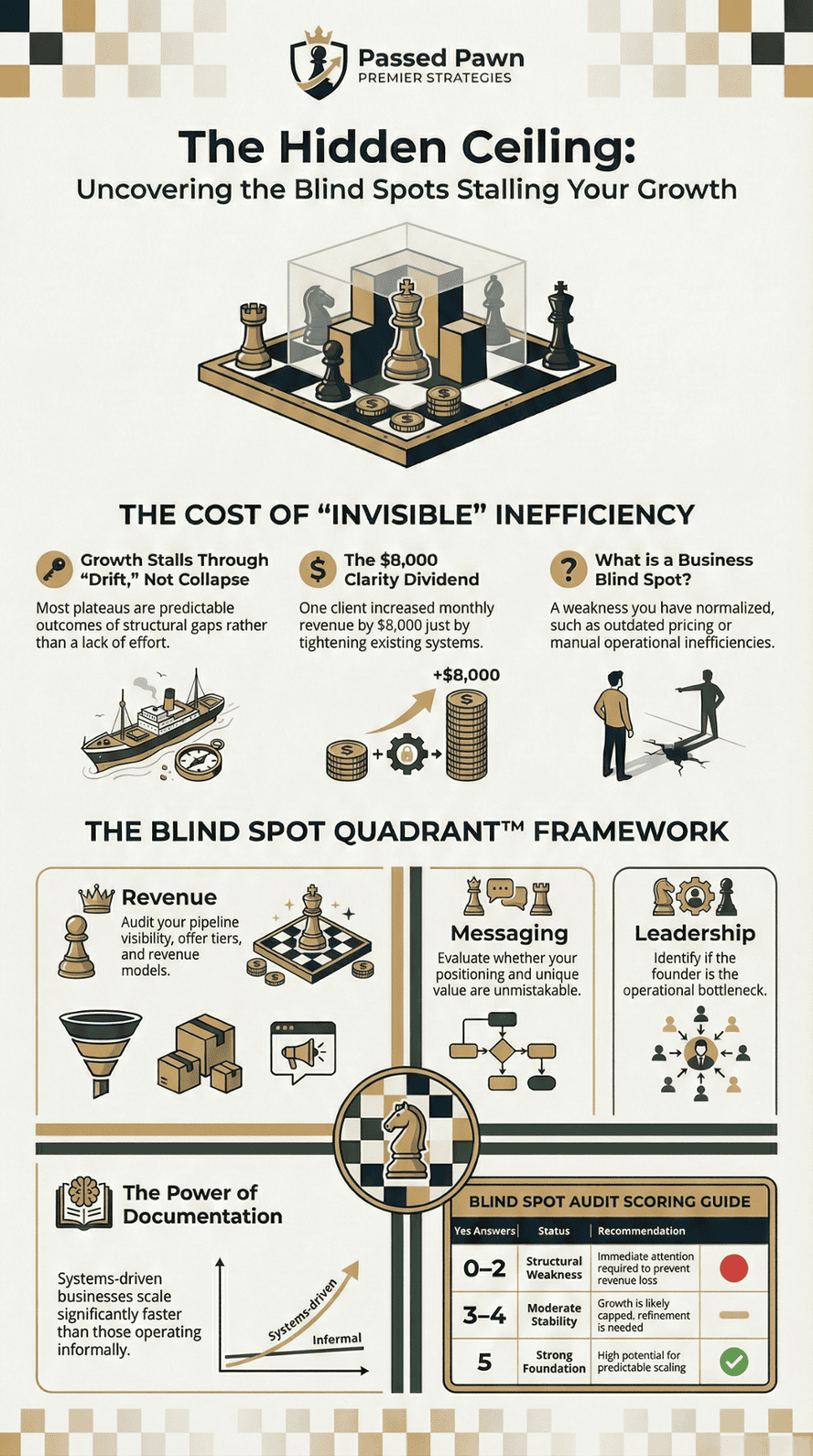
A service-based client came to me frustrated. Traffic was steady. Leads were coming in. Revenue, however, was stuck at the same monthly range for nearly a year. They assumed the issue was “not enough leads.”
It wasn’t.
- After reviewing their pipeline, we found:
- No defined follow-up cadence
- No tiered offers
- No structured upsell
- No client journey mapping
- No conversion tracking beyond inquiries
Nothing dramatic. Just quiet gaps.
Within 60 days of restructuring their revenue strategy and tightening systems, they increased monthly revenue by over $8,000 without increasing traffic. They didn’t need more visibility. They needed clarity. That’s the cost of blind spots.
What Is a Business Blind Spot?
A business blind spot is a weakness you’ve normalized. It’s the pricing you haven’t reevaluated. The messaging that feels clear in your head but confuses buyers. The operational inefficiencies you tolerate because they “work for now.” Blind spots feel familiar. And familiar things don’t trigger urgency. That’s why they linger.
Why Businesses Plateau (Data Doesn’t Lie)
Research consistently shows that small businesses plateau not from lack of effort, but from structural breakdown:
- Most small businesses do not track customer acquisition cost precisely.
- Many service businesses do not have a documented client journey.
- A large percentage of founders cannot accurately predict next month’s revenue.
Businesses that implement documented systems scale significantly faster than those that operate informally. Plateaus are not random. They are predictable outcomes of structural gaps.
The Blind Spot Quadrant
To make this practical, here’s the framework I use to diagnose growth ceilings:
Imagine four quadrants.
1️⃣ Revenue Structure
Is your pipeline visible? Do you have defined offer tiers? Are you maximizing lifetime value? Is pricing aligned with positioning?
If revenue feels inconsistent, this quadrant is leaking.
2️⃣ Messaging Clarity
Can someone describe what you do in one sentence? Is your positioning unmistakable? Are you selling outcomes or explaining services?
If conversion feels unpredictable, this quadrant needs refinement.
3️⃣ Operational Systems
Are processes documented? Are metrics tracked weekly? Is automation replacing manual effort? Could your business function for two weeks without you?
If growth feels chaotic, this quadrant is underdeveloped.
4️⃣ Leadership & Decision Architecture
Are you postponing necessary changes? Are pricing decisions avoided? Are you staying busy instead of strategic? Are you the bottleneck?
If income feels capped, this quadrant is likely the constraint.
Most businesses do not fail across all four quadrants. They leak in one or two, and that’s enough to cap growth.
Why You Can’t See It Yourself
There are psychological reasons.
- Confirmation bias reinforces existing beliefs.
- Emotional attachment protects outdated decisions.
- Familiarity makes inefficiency invisible.
- Survival mode keeps you tactical instead of strategic.
You defend what you built, and unintentionally protect what’s holding you back. That’s not weakness. It’s human. But growth requires objectivity. Objectivity requires distance.
The Real Cost of Ignoring Blind Spots
Blind spots do not explode. They compound.
They show up as:
- Plateaued revenue
- Burnout
- Pricing hesitation
- Random marketing efforts
- Leadership fatigue
- Stalled scalability
You can hustle through a month. You cannot hustle through a structural ceiling. If your business is perfectly structured for its current income level, it will continue producing that income. Structure determines ceiling.
What a Strategic Diagnostic Actually Does
A true diagnostic session does not motivate. It clarifies.
It identifies:
- Revenue leverage gaps
- Positioning weaknesses
- Operational inefficiencies
- Leadership constraints
- Priority decisions
It shows you what you cannot see from inside the system. Not by guessing. By analyzing structure. That’s the difference between tactical noise and strategic growth.
Every Business Has Blind Spots
The question is not whether you have them.
The question is how expensive yours are.
If you are serious about scaling a service business, building predictable revenue, and implementing a real growth strategy instead of reacting month to month, guessing is not a strategy.
A 15-minute strategy diagnostic can uncover more than another quarter of trial-and-error.
If you’re ready to identify what’s quietly holding your growth back, book your discovery call.
Let’s uncover what you can’t see.
00:00
- Hustle_Can_t_Fix_Structural_Blind_Spots00:00